
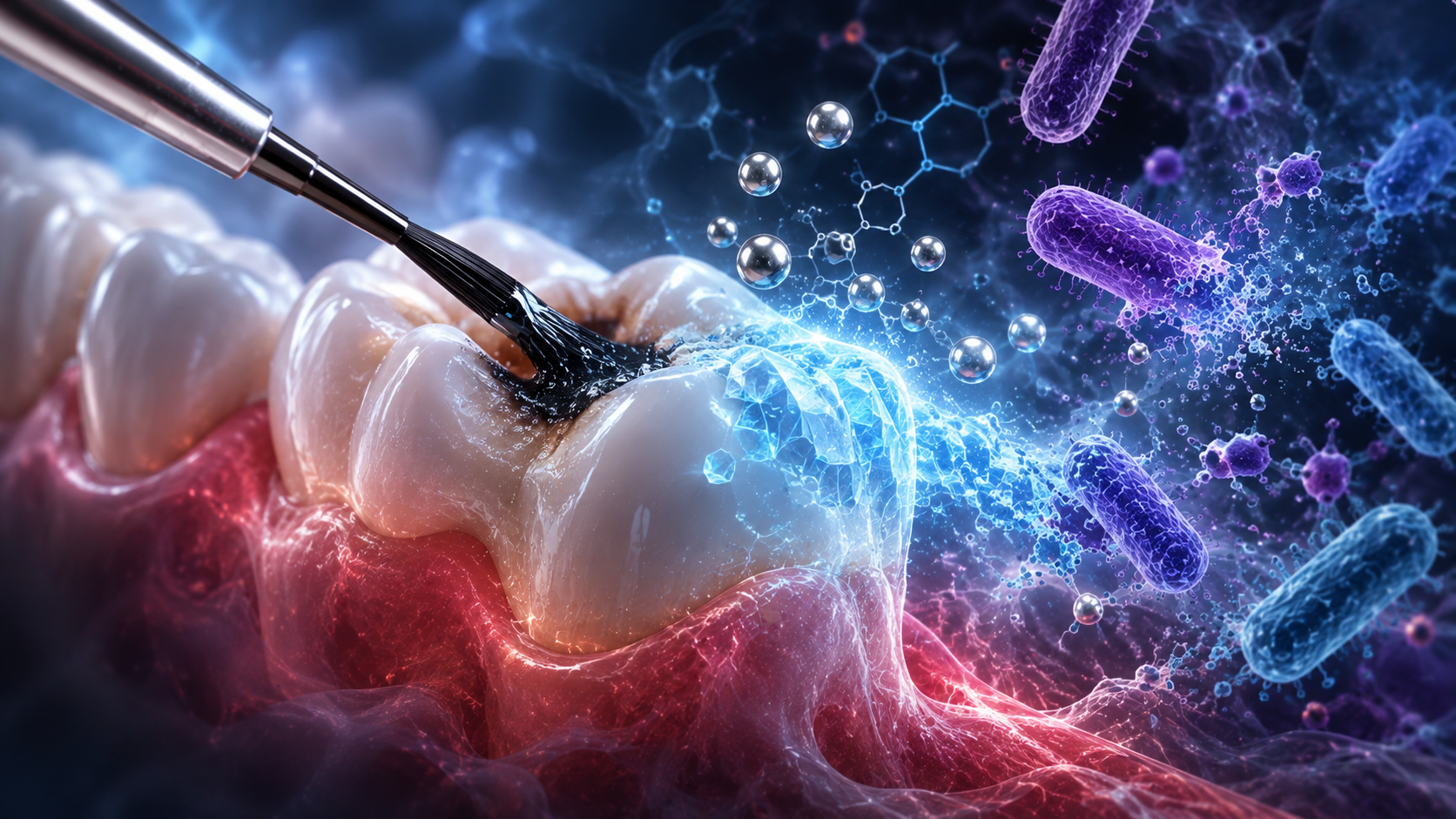
“Well, my friend, it looks like you have a baby cavity on this baby tooth,” says Dr. Molar.
Cathy, a six-year-old girl with extreme fear of not just the dentist but even the dental chair itself, looks up with wide eyes, hoping her mom will agree to leave quickly. Her mom starts discussing treatment options with Dr. Molar and they stop at the name SDF, “silver diamine fluoride.” Dr. Molar explains that SDF is a popular alternative to fillings for kids like Cathy. Instead of drilling a baby tooth that will soon fall out, SDF simply stops the cavity from growing.
Of course, both Cathy and her mom are happy she does not need a filling and opt for “tooth vitamins” over a traditional filling. But the real question is what is SDF and how does “paint” replace drilling and fillings?
History of Silver Diamine Fluoride
Silver diamine fluoride, commonly referred to as SDF, was developed in the 1960s and first approved for therapeutic use in Japan. Today, other countries like the US, have approved lower concentrations of SDF for treating dentinal hypersensitivity, a clinical condition where patients experience short, sharp pain in response to external stimuli like cold foods and sugary drinks [1]. This works because silver in SDF binds with the dentin organic protein matrix, blocking exposed dentin tubules from coming in contact with the oral cavity and what lies within.
However, as seen with Cathy, SDF use has increased in popularity, particularly in pediatric offices, for its off-label use: cavity management. Nevertheless, it is important to note that SDF does not restore the tooth the same way fillings do.
Does SDF Regenerate Lost Enamel?
No, while SDF does not regenerate lost enamel nor replace it with composite like fillings, research studies show that SDF can enhance remineralization of enamel [1,3]. Notice “regeneration” and “remineralization,” although related, are very different.
Interestingly, tooth enamel, which is the outermost layer of the tooth, is the hardest tissue of the body — even harder than bone! This, among other unique mechanical and structural properties, comes from enamel containing large amounts of hydroxyapatite, a calcium-phosphate mineral.
Nevertheless, just because it is the strongest tissue in the body does not mean enamel is indestructible and resistant to all forces. In fact, acidic attacks from food and plaque are the most common cause of enamel degradation. As a defense against these acid-caused reactions, the body produces saliva, which works as a buffer in the oral cavity. However, when the pH of the mouth falls below 5.5, the hydroxyapatite starts breaking down in a process known as demineralization. Fortunately, if dentists catch this decay early enough, they can preserve the enamel’s integrity by replacing lost minerals like calcium and phosphate. This process is known as remineralization.
After excessive decay, the integrity of enamel is no longer recoverable because there is no remaining structure to strengthen. At this point, dentists rely on restorative treatments like fillings or regenerative treatments to restore the lost or damaged tissue. So just as one may expect, remineralization and restorative treatments are much easier than regenerative treatments because there is literally more of the original structure to work with.
Looking back at SDF, we now understand that while it neither restores nor regenerates lost tissue, we can view it as a way to “pause” (i.e. “arrest”) cavity development and strengthen remaining enamel.
How does SDF “arrest” cavities?
“Arresting” cavities involves two main steps. The first is stopping enamel decay by inhibiting or killing the oral bacteria causing it. The second is strengthening the leftover tooth structure to ensure its stability. Based on experimental studies, we have a general understanding of how silver diamine fluoride (Ag(NH3)2F) completes both of these steps. Upon application to the tooth, SDF dissociates from Ag(NH3)2F into silver ions, ammonia, and fluoride ions. By breaking down the name SDF, and in turn its composition, we can learn how its chemical and biological interaction with the oral cavity leads to its success in arresting cavities.

Figure 1 – Mechanism of SDF in Caries Treatment [2]
Silver
Beginning with silver, we see that cationic silver interacts with hydroxyapatite (the major component of enamel) to form metallic silver and silver phosphate. Since our saliva is rich in chloride ions, silver phosphate reacts with the chloride ions to form silver chloride (AgCl), which can now slowly release silver cations [2]. These silver cations serve as the primary antimicrobial agent of SDF when their positive charge disrupts the negatively charged components of the bacteria’s inner membrane, causing it to separate from the cell wall. This leads to potassium ion leakage and ATP depletion, which ultimately limits the ability of the bacterium to grow and divide.
Additionally, silver ions interfere with the sulfhydryl groups of bacterial enzymes. In doing so, they destabilize the protein structural conformation and interfere with essential metabolic functions such as cellular respiration, DNA replication, and cell wall synthesis. Therefore, the silver in SDF inhibits oral bacteria growth that originally caused the cavity of interest.
Diamine
Next, we see how the “diamine” (i.e. two ammonia groups) in SDF plays an important role in its stability before application and its function to prevent further decay [2]. Ammonia forms a diamine-silver complex that prevents premature precipitation of silver by stabilizing its dissolved form. This ensures specificity in that the silver ions do not react unintentionally with halides but only precipitate at the location of the cavity. The second important function of ammonia in SDF comes from its basicity. As mentioned earlier, demineralization occurs under acidic conditions. Therefore, by adding a weak base, like ammonia, to the area of interest, we raise the pH of the microenvironment of the cavity, halting acid-driven erosion and preparing the tooth for remineralization.
Fluoride
Now that bacterial growth is inhibited and the pH is increased, the fluoride in SDF works with phosphate and calcium ions from saliva to form fluorohydroxyapatite (FHA). The main differences between FHA and hydroxyapatite come from fluoride ions being smaller in size and more electronegative than hydroxide ions. Fluoride ions can diffuse more deeply into the tooth and fit more tightly into a crystalline structure. Through this mechanism, SDF promotes the precipitation of a denser, more acid-resistant apatite layer.
So then, if SDF can “arrest” cavities and strengthen enamel, why don’t we use it in adults?
Actually, SDF is used to treat adult caries; however, it is more common in pediatrics.
In a prospective study from 2025, Dr. Rashid examined the efficacy of SDF on arresting adult caries by comparing two groups of patients. One group received a single application of 38% SDF while the other group received a fluoride varnish. After 6 months, 85% of lesions in the SDF group were arrested while 45% of the fluoride group’s lesions were arrested, showing that SDF was more successful [4]. However, 90% of the SDF-treated teeth had stains, meaning 5% of the SDF group had stained teeth without benefitting from the antimicrobial properties of SDF. Therefore, one of the reasons SDF is used less commonly in adults is staining.
Since pediatric patients mostly get cavities in baby teeth that will eventually fall out, families easily accept some temporary staining until adult teeth grow in. However, for adults, the consequence of silver-stained teeth is a huge aesthetic drawback that is not favored unless for molars of high-risk patients.
These high-risk patients include medically compromised patients, older adults and frail seniors, and patients with special needs. For these populations, both dentists and patients favor SDF over intensive dental procedures because it requires less post-op directions, is less expensive, and requires less cooperation from patients.
In a geriatric study, Kettlekamp et al. analyzed a group of SDF-treated adults to see how researchers and dentists can optimize SDF treatment. Specifically, they looked at techniques to increase survival time of the tooth and to limit/delay rapid oral health deterioration (ROHD), which is commonly caused by caries on coronal and root surfaces [5]. This study found that multiple reapplications of SDF on the affected site increased survival time of the tooth but was still limited depending on the patient’s baseline restorative treatment needs. This study suggests SDF is a good tool in geriatric dentistry but should be paired with other treatment options.
Weighing the Pros & Cons
As with every foreign material that we choose to use in the human body, there are always advantages and disadvantages. Nevertheless, while there may be no perfect solution for each dental condition, dentists are selective in suggesting the most advantageous material for the optimal oral health, aesthetic, and cost. Some of these pros and cons are presented visually in Figure 2 and in more detail in Table 1.

Figure 2 – The Good, the Bad, the Ugly [1] – SDF is good at arresting cavities without the need for drilling, but it can be cytotoxic to oral cells at high concentrations, and as a part of its mechanism, it stains teeth.
Table 1 – Comparing the Pros and Cons of SDF
| Pros | Cons |
| SDF is cheaper compared to a restorative filling | Black discoloration |
| Antibacterial and antifungal activity | May cause cytotoxic effects on pulp cells, gingival fibroblasts, epithelial cells, and deciduous tooth stem cells, mediated by oxidative stress and apoptosis [1] |
| Manages hypersensitivity | Does not restore physical shape of tooth (not regenerative) |
| Fast and does not require drilling or numbing | Requires re-application every 6-12 months |
Interested in learning more about why only a small number of materials account for the majority of clinical applications within dentistry? Check out our ToothEngineers Podcast on Dental Biomaterials.
What are the alternatives to SDF?
Silver diamine fluoride’s appeal to pediatric patients and now adults is the easy application that requires neither drilling nor anesthesia/pain. The closest alternative to SDF is Curodont, which also non-invasively treats tooth decay. However, Curodont is only effective on early-stage tooth decay and thus does not have the full antibacterial potential of SDF. For more information, check out our blog post on Curodont!
Recently, researchers have been working on modified formulations and techniques using SDF that would limit the discoloration. For example, during the COVID-19 pandemic, a journal article on the use of Silver Modified Atraumatic Restorative Technique (SMART) explained how the use of SDF with potassium iodide (KI) and glass ionomer cement (GIC) was aesthetically and health-wise beneficial [6]. In the SMART technique, the dentist applies KI right after the first layer of SDF. This potassium iodide reacts with the unreacted silver ions and forms a foam, which essentially prevents excess silver from staining the tooth. Next, the dentist applies GIC over the area to seal the restoration and limit staining. However, GIC itself has a translucent color and therefore does not fully cover the silver stain.
Looking Forward
As researchers continue to explore safer and modified formulations of SDF, biomaterials will continue to improve the quality and accessibility of dental care. New techniques like SMART will reducing patient chairtime and more importantly, limit anesthesia and pain for pediatric, geriatric, and anxious patients.
As we learned, SDF is not a viable alternative to fillings in all situations, it is beneficial for quickly and “easily” arresting cavities in patients like Cathy. Six months later, Cathy returns to Dr. Molar, no longer anxious or afraid of his touch but excited to show him that she lost her baby silver tooth!
Biomaterials have effects beyond the oral health of the patient. In dentistry they can optimize patient care by transforming fear into comfort, preserving natural tooth structure, and expanding accessible options for patients of all ages.
Check Out Our Other Blogs
Did you enjoy our article? We have more great content (links below)!
- Chipped a Tooth? Don’t Worry, Your Baby Teeth Will Save You!
- The Future of Facial Reconstruction: A Novel 3D Printing Service That Can Remodel Your Jaw!
- Need a Dental Implant? Just Regrow Your Teeth!
- Vaping is BAD for you and your teeth…right???
- Curodont: A New Way to Treat Cavities Without the Drill
- Dental Bioprinting: The Future of Dentistry?
- Salivary Glands: The Unsung Heroes of Oral Health
- The Teeth Whitening Powder! Future of Whitening?
- How Dental Biologics Are Shaping the Future of Dentistry?
- Gum Disease and The Heart… It’s Not A Loving Relationship
- Enamel Regeneration: A Dental Revolution on the Horizon
- Ozempic Teeth: From Waist Line To Gum Line
- Unveiling the Truth: Debunking Myths about Fluoride
- Be Wary of PRIME… It Could Ruin Your Teeth
- Hydrogen Peroxide Teeth Experiment: Be Careful With Whitening
- Dental Science Experiments: Hydrochloric Acid and Teeth
- Medium: What It Means To Be A Tooth Engineer
Follow Us!
If you liked this article, then please subscribe to our YouTube Channel and Medium Blog for more Tooth Engineers content. You can also find us on TikTok, Instagram and Facebook.
References
- Ezhilarasan D. Silver diamine fluoride for dental caries: the good, the bad, and the ugly – insights from preclinical evidence. Arch Oral Biol. 2026;188:106631. doi:10.1016/j.archoralbio.2026.106631
- Jamal D, AlMushayt A, Abujamel T, Bamashmous S, Bamashmous N, Alamoudi N. Silver diamine fluoride: the science behind the action – a narrative review. BMC Oral Health. 2025;25:1195. doi:10.1186/s12903-025-06107-x
- American Dental Association. Silver diamine fluoride. Updated September 1, 2026. Accessed November 17, 2026. https://www.ada.org/resources/ada-library/oral-health-topics/silver-diamine-fluoride
- Rashid ME. Effectiveness of silver diamine fluoride in arresting caries in adult patients. J Pharm Bioallied Sci. 2025;17(suppl 2):S1288-S1290. doi:10.4103/jpbs.jpbs_240_25
- Kettelkamp K, Desai J, Lewis S, Comnick C, Marchini L. Outcomes of silver diamine fluoride (SDF) treatment among older adults: a retrospective analysis. Spec Care Dentist. 2025;45(2):e70013. doi:10.1111/scd.70013
- Natarajan D. Silver modified atraumatic restorative technique: a way towards “SMART” pediatric dentistry during the COVID-19 pandemic. Front Dent. 2022;19:12. doi:10.18502/fid.v19i12.9215
- Sedek EM, Holiel AA. Next-generation strategies for enamel repair and regeneration: advances in biomaterials and translational challenges. Tissue Eng Regen Med. 2025;22(6):771-789. doi:10.1007/s13770-025-00725-w
- OpenAI. Silver diamine fluoride dental treatment. AI-generated image. 2026. (Cover Photo)


