
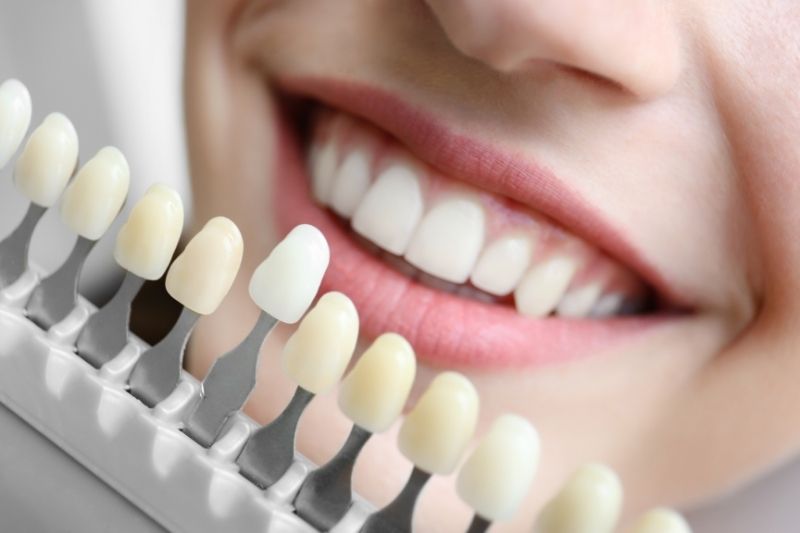
Looking into teeth whitening? Concerned about the safety and efficacy of the whitening options? Heard about the new teeth whitening powder that whitens your teeth and also strengthens the enamel!? Well, you are at the right place. In this post we will discuss all of the above and more.
Let us start off with a very basic question. What do you think about the two images above? If I were to ask you which one looks better, what would you say?

The one with the whiter teeth, right? If that’s the case, believe me, you are not alone. According to a PubMed article, about 85.9% adults reported a desire for teeth whitening. Although slightly yellow teeth do not necessarily mean they are unhealthy or unkept, they are completely fine (yellow is the natural color of teeth), a shiny white smile, however, just appears more aesthetically pleasing.
But Doc, even though I brush two times a day for two full minutes, floss regularly, and use mouthwash, my teeth still are not bright white… This is actually a lot more common than you might think. Even with healthy habits, some degree of discoloration can happen to almost anyone. Our teeth naturally pick up stains and change color over time, and it doesn’t mean you aren’t doing a good job with your oral care.
A bright, white smile has long been associated with health, youth, and confidence. Whether it’s in photos, during conversations, or in professional settings, our teeth often play a bigger role in first impressions than we realize. Over time, however, even the healthiest teeth can lose their sparkle. This is where teeth whitening comes in—one of the most popular and accessible cosmetic dental treatments today.
But what exactly causes teeth to stain? How does whitening work? And is it safe for everyone? Let’s break it all down.
Why Do Teeth Lose Their Whiteness?
Despite good oral hygiene, tooth discoloration is a common occurrence. Teeth naturally darken as we age, but several everyday factors can speed up the process: Food and beverages: Coffee, tea, red wine, soda, berries, and sauces like soy or tomato are common culprits. Smoking and tobacco use: Nicotine and tar penetrate tooth enamel, causing yellow or brown stains. Poor oral hygiene: Infrequent brushing and flossing allow plaque and stains to build up. Medications: Certain antibiotics (like tetracycline), antihistamines, and blood pressure medications can affect tooth color. Genetics: Some people naturally have thicker enamel or brighter dentin than others.
- Food and beverages: Coffee, tea, red wine, soda, berries, and sauces like soy or tomato are common culprits.
- Smoking and tobacco use: Nicotine and tar penetrate tooth enamel, causing yellow or brown stains.
- Poor oral hygiene: Infrequent brushing and flossing allow plaque and stains to build up.
- Medications: Certain antibiotics (like tetracycline), antihistamines, and blood pressure medications can affect tooth color.
- Genetics: Some people naturally have thinner enamel or brighter dentin than others.


How Teeth Whitening Works
Teeth whitening treatments use bleaching agents—most commonly hydrogen peroxide or carbamide peroxide—to break down stains on and within the enamel. These agents penetrate the tooth surface and oxidize the discoloration, making teeth appear lighter.
Whitening does not change the natural structure of your teeth; instead, it removes or reduces stains that dull their appearance.
Types of Teeth Whitening Options
Today, there are more whitening options than ever, ranging from professional treatments to DIY solutions. Each has its pros and cons. Cost and time commitment can vary widely between these options. In-office treatments typically cost between $400 and $1,000 per session and are completed in about an hour. Dentist-prescribed take-home kits often range from $150 to $400 and require daily use for one to two weeks. Over-the-counter products are the most affordable, usually costing $20 to $100, but they need to be used consistently over several days to a few weeks to see noticeable results. Knowing these ranges can help you choose a whitening method that fits your budget and schedule.
1. Professional In-Office Whitening
This is the fastest and most effective option. Performed by a dental professional, in-office whitening uses high-concentration bleaching agents, often enhanced with special lights or lasers.
Pros:
- Immediate results (often several shades whiter in one visit).
- Supervised by professionals.
- Customized for your teeth and sensitivity level
Cons:
- Higher cost compared to at-home options

2. Dentist-Prescribed Take-Home Kits
These kits include custom-fitted trays and professional-grade whitening gel. You use them at home for one to two weeks.
Pros:
- Effective and safer than over-the-counter products.
- Gradual, natural-looking results.
- Less sensitivity than in-office treatments for some patients.
Cons:
- Results take longer.
- Requires consistency.
3. Over-the-Counter Whitening Products
These include whitening strips, gels, pens, toothpaste, and mouth rinses. The new teeth whitening powder may be another OTC product.
Pros:
- Affordable and easily accessible.
- Convenient for quick touch-ups.
Cons:
- Lower concentration of whitening agents.
- Results vary widely.
- A one-size-fits-all approach may increase sensitivity or uneven whitening.
With the new powder, it we may be able to combat the sensitivity concern, as it is said to deposit minerals on the surface of enamel that will go in and block the small holes and scaffolds of the enamel surface.

Does Teeth Whitening Work for Everyone?
Teeth whitening works best on yellow or light brown stains, especially those caused by food, drinks, or smoking. However, it may be less effective for:
- Gray or blue-tinted discoloration.
- Stains caused by certain medications.
- Teeth with crowns, veneers, or fillings (these do not whiten!).
This is why consulting a dental professional before whitening is important—they can set realistic expectations and recommend the safest option.
Is Teeth Whitening Safe?
When done correctly, teeth whitening is considered safe. However, misuse or overuse can lead to side effects such as:
- Tooth sensitivity.
- Gum irritation.
- Enamel damage (rare, but possible with excessive or improper use).
Professional guidance significantly reduces these risks. Using whitening products too frequently or leaving them on longer than recommended does not improve results and may cause harm.


How Long Do Whitening Results Last?
Teeth whitening is not permanent, but results can last anywhere from several months to a few years, depending on lifestyle habits.
To maintain a brighter smile:
- Brush and floss regularly.
- Limit staining foods and drinks.
- Use a straw for dark beverages.
- Avoid smoking.
- Schedule regular dental cleanings.
- Consider occasional touch-up treatments.
Common Myths About Teeth Whitening
Myth: Whitening weakens teeth
Fact: When used properly, whitening does not damage healthy enamel.
Myth: Whitening toothpaste can dramatically whiten teeth
Fact: These toothpastes help remove surface stains but won’t significantly change tooth color.
Myth: Natural remedies like lemon or charcoal are safer
Fact: Many DIY remedies are abrasive or acidic and can harm enamel over time.
A Healthier Teeth Whitening Option?
Researchers reporting in ACS Nano have created a teeth whitening powder that is activated by the vibrations of an electric toothbrush. Teeth whitening works by producing reactive oxygen species (ROS). The ROS works by breaking down the molecules responsible for stains. This, in turn, also weakens the enamel. The new teeth whitening powder only produces ROS when triggered by the vibrations of an electric toothbrush, thus significantly reducing the time of the ROS on the enamel. This powder has many minerals, including strontium, calcium, and barium. These minerals form deposits on the enamel, rebuilding key structures within it. Thus, it strengthens enamel while breaking down the stains at the same time.
Final Thoughts
Teeth whitening is a simple yet powerful way to enhance your smile. With so many options available, it’s easier than ever to find a solution that fits your budget, lifestyle, and dental needs. The key is choosing safe, effective methods and understanding that whitening is part of an overall oral health routine—not a replacement for it. That said, there are concerns about tooth sensitivity, gum irritation, and possible enamel damage with traditional methods. New research, on the other hand, does seem promising. Newer whitening methods and materials, such as the teeth whitening powder, do seem to be heading in the right direction.
If you’re considering teeth whitening, start with a dental consultation to determine the best approach for your smile. After all, a healthy smile is always in style—and a brighter one just makes it shine a little more.
Check Out Our Other Blogs
Did you enjoy our article? We have more great content (links below)!
- Vaping is BAD for you and your teeth… right???
- Curodont: A New Way to Treat Cavities Without the Drill
- Dental Bioprinting: The Future of Dentistry?
- How Dental Biologics Are Shaping the Future of Dentistry?
- Gum Disease and The Heart… It’s Not A Loving Relationship
- Enamel Regeneration: A Dental Revolution on the Horizon
- Ozempic Teeth: From Waist Line To Gum Line
- Unveiling the Truth: Debunking Myths about Fluoride
- Be Wary of PRIME… It Could Ruin Your Teeth
- Hydrogen Peroxide Teeth Experiment: Be Careful With Whitening
- Dental Science Experiments: Hydrochloric Acid and Teeth
- Medium: What It Means To Be A Tooth Engineer
References:
- Silva FBD, Chisini LA, Demarco FF, Horta BL, Correa MB. Desire for tooth bleaching and treatment performed in Brazilian adults: findings from a birth cohort. Braz Oral Res. 2018;32:e12. Published 2018 Mar 8. doi:10.1590/1807-3107bor-2018.vol32.0012 https://pubmed.ncbi.nlm.nih.gov/29538477/
- Sulieman M. An overview of tooth discoloration: extrinsic, intrinsic and internalized stains. Dent Update. 2005;32(8):463-471. doi:10.12968/denu.2005.32.8.463 https://pubmed.ncbi.nlm.nih.gov/16262034/
- Pandey SH, Patni PM, Jain P, Chaturvedi A. Management of intrinsic discoloration using walking bleach technique in maxillary central incisors. Clujul Med. 2018;91(2):229-233. doi:10.15386/cjmed-852 https://pmc.ncbi.nlm.nih.gov/articles/PMC5958990/
- Carey CM. Tooth whitening: what we now know. J Evid Based Dent Pract. 2014;14 Suppl:70-76. doi:10.1016/j.jebdp.2014.02.006 https://pubmed.ncbi.nlm.nih.gov/24929591/
- Heymann, H. Tooth whitening: facts and fallacies. Br Dent J 198, 514 (2005). https://doi.org/10.1038/sj.bdj.4812298
- Casado BGS, Moraes SLD, Souza GFM, et al. Efficacy of Dental Bleaching with Whitening Dentifrices: A Systematic Review. Int J Dent. 2018;2018:7868531. Published 2018 Oct 30. doi:10.1155/2018/7868531 https://pmc.ncbi.nlm.nih.gov/articles/PMC6232812/
- This new tooth powder whitens teeth without damage | ScienceDaily


