
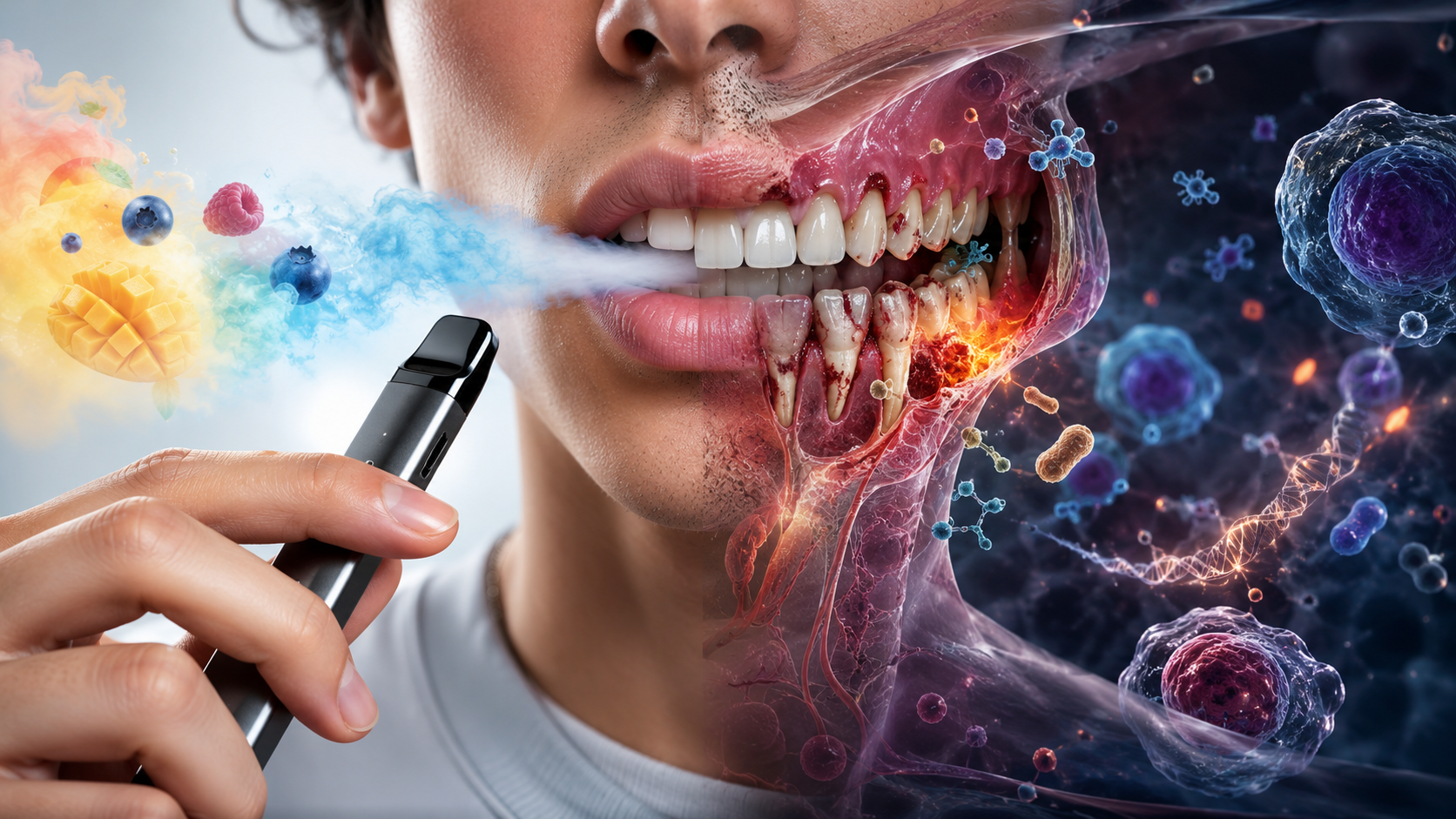
The number of times I’ve walked into a high school bathroom and immediately recognized the smell of a vape is absurd. At this point, I could probably tell you the flavor of the week the same way I can tell what’s being served in the cafeteria.
Vaping has become so common that many people barely think twice about it. Unlike coffee, it doesn’t leave obvious stains on your teeth. Unlike cigarettes, it isn’t surrounded by decades of anti-smoking campaigns and warning labels. People don’t step outside for a vape break the way smokers step outside for a cigarette. They vape while driving, studying, scrolling through social media, and hanging out with friends. It quietly works its way into everyday activities.
Part of the reason is perception.
For decades, smoking has been associated with yellow teeth, lung cancer, and warning labels. Most people know cigarettes are harmful before they ever touch one. Vaping entered the conversation differently. It was marketed as a cleaner, newer, and better alternative.
As a result, many people compare vaping to smoking instead of evaluating it on its own. The thought process becomes: At least I’m not smoking.
But “less harmful than cigarettes” is not the same thing as “harmless.”
Is newer actually better?

Though they’ve only recently exploded in popularity, alternatives to cigarettes have existed since the 1960s (1). These products were originally designed to help people move away from traditional tobacco use. However, in retrospect, they may have created an entirely new set of problems.
The World Health Organization (WHO) states that there is insufficient evidence to conclude that e-cigarettes are effective smoking cessation tools, and concerns about their health effects continue to grow (1).
The question, then, is not whether vaping is better than smoking. While some users turn to e-cigarettes as an alternative to cigarettes, others are drawn in by flavored products, social acceptance, convenience, and the perception that vaping is relatively harmless. Regardless of why someone starts, the more important question is what vaping is actually doing to the tissues inside your mouth.
How a Vape Works
Most scientific papers will spend several paragraphs explaining the engineering behind a vape. For both my sake and yours, here’s the simplified version:
- Press button.
- A metal coil heats up.
- E-liquid becomes an aerosol.
- Aerosol gets inhaled.
- Repeat.
Simple, right?
Not really.
Most people think of vape aerosol as flavored water vapor. In reality, researchers have found that it can contain ultrafine particles, heavy metals, nicotine, volatile organic compounds, and other substances that come into direct contact with the tissues inside your mouth every time you take a puff (1). While e-cigarettes were often promoted as an alternative to traditional cigarettes, many products still deliver substantial amounts of nicotine. The difference is not the absence of nicotine, but rather the method of delivery: aerosolized liquid instead of combustible tobacco.
The Problem Isn’t Just Your Teeth
One of the more surprising findings from recent research isn’t what vaping does to your teeth, it’s what it may be doing to the cells that maintain them.
Your mouth is constantly repairing itself.
Cells die and are replaced. Tissues heal.
Tiny injuries recover before you even notice them.
Most of the time, this process runs quietly in the background.
Problems begin when damage starts accumulating faster than the body can repair it.
Recent research suggests that vape aerosol can increase oxidative stress within oral tissues. Over time, this stress may damage DNA and interfere with the systems cells use to repair themselves (2).
Researchers have observed that some oral cells exposed to this type of stress may die, while others enter a state called senescence, sometimes described as “cellular retirement” (2).
Unlike dead cells, senescent cells remain alive. The catch is that they stop dividing and become less effective at maintaining healthy tissue. Imagine a maintenance worker who still shows up every day but no longer fixes anything. As more of these cells accumulate, keeping tissues healthy becomes increasingly difficult.
One pathway researchers have focused on is p53, sometimes called the “guardian of the genome.” When DNA becomes damaged, p53 helps coordinate repair efforts and prevents damaged cells from continuing to divide. Some evidence suggests that repeated exposure to vape aerosol may place additional stress on these repair systems through oxidative damage (2).
A simplified version of the proposed pathway looks something like this:
Vape aerosol → Oxidative stress → DNA damage → Cellular stress and repair responses
The key takeaway isn’t that vaping instantly causes disease. Rather, oral health depends on a balance between damage and repair. When the breakdown begins to outpace the body’s ability to recover, problems start to emerge.
(2) Figure 1

(2) Figure 2

Tissue-Level Consequences
While most of the stuff in vape liquid seems harmless at room temperature, heating it changes things. Once it becomes an aerosol, it doesn’t just “sit” in the mouth; it comes into direct contact with the tissues inside the mouth and airway. The early effects include a dry throat and coughing, but with repeated use, it shifts into longer-term biological changes.
E-cigarette aerosol has been shown to trigger inflammatory responses in respiratory epithelial cells and may increase susceptibility to infection (3). In simple terms, the tissues lining your mouth and airway begin to react more aggressively and less efficiently over time.
In the oral cavity specifically
Studies have linked vaping to a few consistent outcomes:
- Oral mucosal irritation and lesions
- Changes in the oral microbiome
- Altered saliva composition
- Higher risk of cavities and periodontal disease
Much of this stems from a combination of disrupted oral bacterial balance and changes in saliva. Beneficial bacteria get suppressed, while bacteria linked to gum disease tend to increase (3). On top of that, saliva may lose some of its natural antibacterial and protective properties, which basically removes one of your mouth’s main defense systems.
That said, the research isn’t yet fully consistent, since vaping is relatively new, making it a great research topic for students and dentists alike. (connect to intended audience)
What now?
So is vaping bad for your teeth?
Yes.
While researchers are still working to understand the full long-term effects of e-cigarettes, the evidence we have today points in one direction: vaping disrupts the systems that keep your mouth healthy. It increases oxidative stress, alters the oral microbiome, changes saliva composition, and has been linked to a higher risk of cavities and periodontal disease.
The problem is that these changes often happen long before you notice them. By the time something feels wrong, the damage may have been accumulating for months or years.
So here’s the takeaway: if you vape, tell your dentist. Not as a confession, just as information they need to do their job. The more they know, the better they can help protect your oral health.
And don’t let the flavor fool you.
“Blue Rasberry” doesn’t mean your mouth is getting a pass.
Check Out Our Other Blogs
Did you enjoy our article? We have more great content (links below)!
- Curodont: A New Way to Treat Cavities Without the Drill
- Dental Bioprinting: The Future of Dentistry?
- Salivary Glands: The Unsung Heroes of Oral Health
- The Teeth Whitening Powder! Future of Whitening?
- How Dental Biologics Are Shaping the Future of Dentistry?
- Gum Disease and The Heart… It’s Not A Loving Relationship
- Enamel Regeneration: A Dental Revolution on the Horizon
- Ozempic Teeth: From Waist Line To Gum Line
- Unveiling the Truth: Debunking Myths about Fluoride
- Be Wary of PRIME… It Could Ruin Your Teeth
- Hydrogen Peroxide Teeth Experiment: Be Careful With Whitening
- Dental Science Experiments: Hydrochloric Acid and Teeth
- Medium: What It Means To Be A Tooth Engineer
Follow Us!
If you liked this article, then please subscribe to our YouTube Channel and Medium Blog for more Tooth Engineers content. You can also find us on TikTok, Instagram and Facebook.
References
- Iacob AM, Escobedo Martínez MF, Barbeito Castro E, et al. Effects of Vape Use on Oral Health: A Review of the Literature. Medicina (Kaunas). 2024;60(3):365. https://doi.org/10.3390/medicina60030365
- Ganapathy V, Jaganathan R, Chinnaiyan M, et al. E-Cigarette Effects on Oral Health: A Molecular Perspective. Food Chem Toxicol. 2025;196:115216. https://doi.org/10.1016/j.fct.2024.115216
- Cichońska D, Kusiak A, Goniewicz ML. The Impact of E-Cigarettes on Oral Health—A Narrative Review. Dent J (Basel). 2024;12(12):404. https://doi.org/10.3390/dj12120404
- OpenAI. (2026). AI-generated illustration showing the hidden oral effects of vaping [Image generated by ChatGPT]. ChatGPT. https://chatgpt.com


