
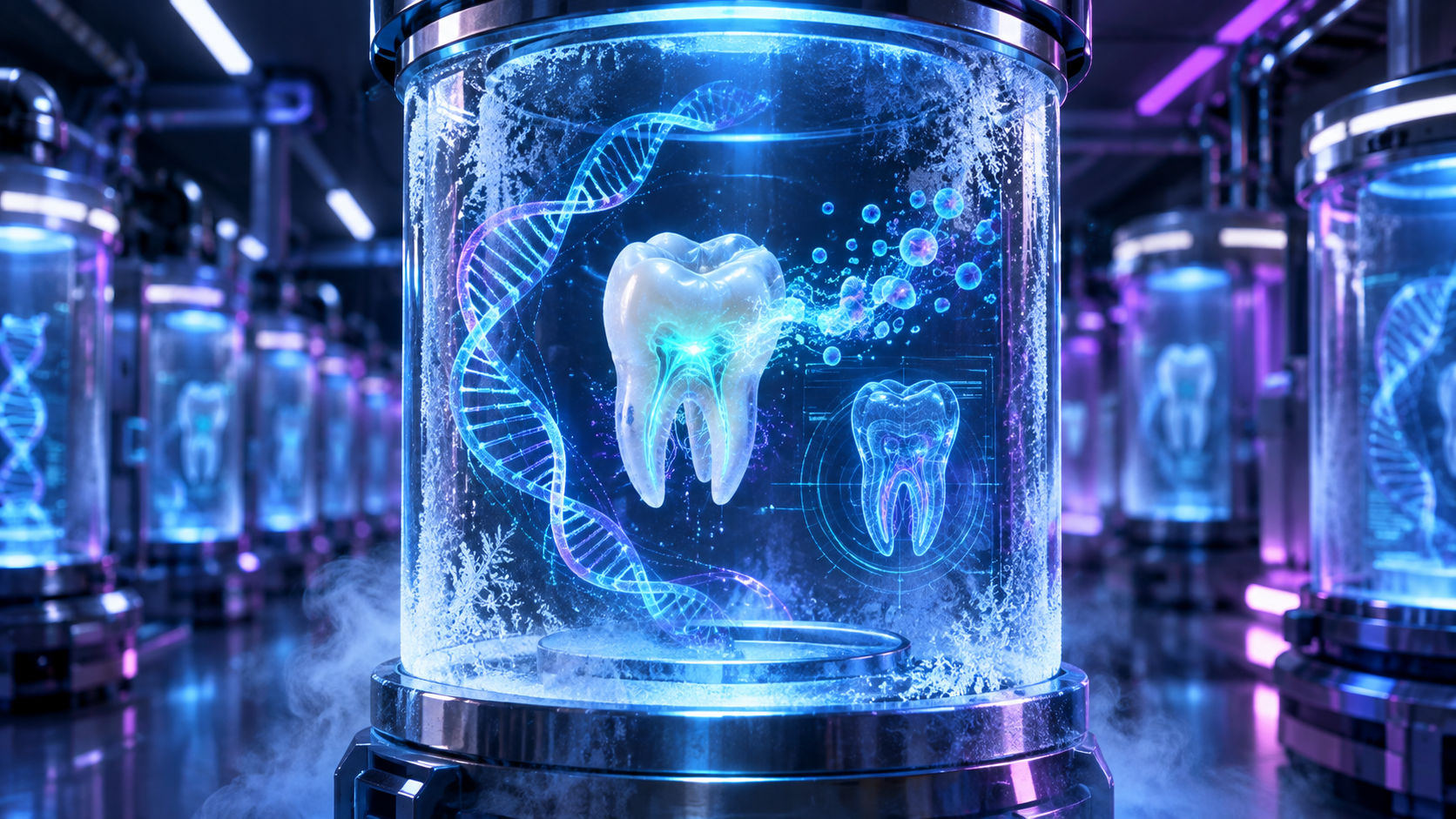
Your kid’s tooth falls out. Normally it goes under a pillow, and the tooth fairy leaves five bucks. But some pediatric dentists now hand parents a brochure with a different offer: Ship the tooth overnight to a lab, freeze the stem cells inside it, and keep them until the day medicine figures out how to use them. The idea is that years later, a chipped tooth or a more serious injury could be repaired using your kid’s own cells.
The pitch sounds a lot like cord blood banking (i.e., saving stem cells from a newborn’s umbilical cord), just later and less awkward. It costs real money, though, and the obvious question is whether you’re paying for science or for hope. A small chipped tooth usually just gets a quick filling-like fix called bonding, but a traumatic hit to the mouth hard enough to kill the inside of the tooth is a different story. And that’s where these cells really start to matter. So I looked at what’s actually in a baby tooth, what these cells can do right now, and what it would take for them to someday grow your kid a new tooth.
What’s actually in a baby tooth?
Every tooth has a soft center called the pulp. It holds the tooth’s blood vessels and nerves. In 2003, a research team led by Songtao Shi at the NIH found stem cells in the pulp of baby teeth that had fallen out on their own. They named them SHED, short for stem cells from human exfoliated deciduous teeth, which is just the scientific way of saying baby teeth that fell out [1].
Stem cells are foundational cells that can develop into other mature cell types. But SHEDs are a limited stem cell type. They can’t become any cell in the body like the embryonic stem cells you hear about in the news. In the lab, they differentiated into cells that form dentin (the hard layer beneath the enamel), fat cells, and cells resembling early nerve cells [1]. They grow rapidly and have a low risk of tumor formation [2]. Since kids lose these teeth anyway, some researchers think SHEDs are the best option for saving a person’s own stem cells for later [3].
Here’s the catch. Pulp stem cells can form mature pulp, dentin, and bone tissue. Enamel, the hard white outer layer, is made by a different cell called an ameloblast. In humans, those cells are gone once enamel formation is complete, which is why enamel can’t grow back [4]. Remember that, because it matters later.

How banking works
A dentist pulls the baby tooth while it’s loose, or parents save it the day it falls out. A lab removes the pulp, expands the stem cells, and freezes them until they’re needed [5]. Frozen pulp cells can be thawed later and still work [6].
Here’s what doesn’t make it into the brochure. Scientists still don’t have a standard way to ensure these cells retain their healing ability after years in a freezer [2]. Researchers in Brazil have even suggested that SHED should be stored in regulated research banks instead of private companies until the science catches up [7].
Then there’s the price. A 2020 review of tooth banks found that the first-time processing fee runs about $500 to $2,000, plus yearly storage fees of about $99 to $264. Some companies offer a flat 20-year plan for about $2,000 to $3,000 instead. Health insurance in the US doesn’t cover it [18]. Depending on the plan, that adds up to a few thousand dollars by the time your kid finishes high school.
What the science can actually do today
The most significant real-world result so far is a 2018 study in China [8]. The patients were kids who had hit a front tooth so hard that the pulp died. When that happens to a young tooth, it stops growing. The root stays short and thin, and the tooth can break or be lost years later.
Researchers took stem cells from each kid’s other baby teeth and placed them inside the injured tooth. After a year, the teeth had grown new pulp with blood vessels and working nerves. The roots also kept growing, which the usual treatment doesn’t do. The team followed 20 of the kids for two years and found no harmful side effects.
That’s a big deal. But look closely at what happened. The cells fixed a tooth that was still in the mouth, and they came from the fresh baby teeth the kids still had. Nobody used cells that had been sitting in a freezer for 15 years.

That’s the part the banks don’t really talk about. A 2024 review found that there still haven’t been large studies testing these cells in lots of different patients. In one study, the cells didn’t help at all when they were used to heal the hole left after a tooth was pulled [6]. And the 2018 study showed that when pulp regrowth works, doctors can use fresh cells from the kid’s other baby teeth. No bank needed.
The alternate future: growing a real tooth from a baby tooth
Let’s imagine it’s 2050. A 35-year-old cracks a back tooth all the way down to the root. Today, a dentist would pull it and place an implant, a metal screw in the jawbone with a fake tooth on top. In this future, her dentist calls the tooth bank instead. The bank thaws the stem cells her parents saved when she was seven and sends them to a lab. A few weeks later, the lab sends back a tiny tooth bud, which is a tooth in its earliest stage. The surgeon places it in the empty spot, and over the next year it grows into a real tooth with its own nerve and blood supply. It also comes with the cushion of tissue that holds natural teeth in place, something an implant never has.
This isn’t totally science fiction. In 2009, scientists in Japan grew a tooth bud in the lab and implanted it into the jaw of an adult mouse missing a tooth. The tooth grew in, lined up with the tooth above it, was strong enough to chew with, and could even feel pain [9]. So a lab-grown tooth has already worked in a living animal, just a mouse.
Here’s what’s standing between that mouse and your kid.
The enamel problem. The mouse tooth was made from two kinds of cells taken from an embryo, and they work as a team. One kind builds the dentin and pulp. The other builds enamel. Banked baby tooth cells are only one type, and adults no longer have enamel-forming cells [4]. Scientists have begun converting lab-made stem cells into early-stage enamel-forming cells that form tiny tissue clumps [10]. That’s real progress, but it’s still happening in a dish, not a mouth.
The size and time problem. A mouse tooth is tiny and grows in a few weeks. A human back tooth takes years to fully form. Nobody knows yet how to make a lab-grown tooth bud turn out the right size and shape for the exact spot in someone’s mouth.
Then there’s the freezer itself. Even if all of this works, doctors might not need banked cells at all. The enamel research above uses lab-modified stem cells called iPSCs, which scientists create by reprogramming regular adult cells, such as skin cells, back into a stem cell state [10]. If that keeps improving, cells taken from you at 35 could do the same job as a tooth frozen when you were 7. That’s what makes banking a strange bet. The future where regrowing teeth works is also the future where you probably don’t need the bank.
There’s also a completely different approach that skips stem cells: Drugs that wake up the backup tooth buds people already have. We covered that in our post on regrowing teeth.
Why would a regrown tooth be better than what we have now?
Fair question, because today’s options work pretty well. A root canal cleans out the inside of a damaged tooth and seals it; then a crown (a cap) is placed on top to protect it. An implant replaces the tooth completely and can last for decades. So what’s the point?
| Option | What you end up with | The downside |
|---|---|---|
| Root canal + crown | Your own tooth, but emptied out inside | Nothing living is left inside the tooth |
| Implant + crown | A metal post in the jawbone with a fake tooth on top | Less feeling, can get infected, not safe for kids who are still growing |
| Regrown pulp (SHED) | Your own tooth, still alive inside | Only works if the tooth is still there |
| Regrown whole tooth | A brand-new real tooth | Hasn’t been done in humans yet |
The biggest advantage is that a regrown tooth is alive. In the 2018 study, the new pulp had functional blood vessels and nerves, as well as a layer of cells that continue to produce dentin [8]. A root canal removes all of that on purpose.
Compared to implants, the big difference is the ligament. Natural teeth sit in a thin layer of tissue that works like a shock absorber and lets you feel how hard you’re biting. Implants are attached straight to the bone, so they can’t feel as much. In one study, people could feel a strip of foil about 21 micrometers thick (thinner than a human hair) between their natural teeth, but with an implant, it had to be about 30 micrometers thick before they noticed it [11]. Implants can also get their own kind of gum disease, called peri-implantitis. A large review estimated it shows up in about 22% of cases, and there isn’t a reliable treatment for it yet [12].
Kids are where this matters most. An implant is fused to the bone, so it stays in the same position while the rest of a kid’s jaw continues to grow around it [13]. A review of implants in patients ages 3 to 18 found they often ended up sitting too high or twisted, and said they should only be used in rare cases [14]. Other options, like removable fake teeth or bridges, don’t work very well for kids either [15]. That’s exactly who the 2018 study helped, since the regrown pulp let the kids’ young teeth keep growing their roots.
How much money could this save?
Probably not much at first. New medical treatments almost always start out expensive, and growing a tooth bud would mean growing cells in a lab separately for every patient. Early versions would likely cost more than an implant, not less.
There’s no cost data on regrown teeth yet because no one has regrown a human tooth. But there is research comparing the options we have now, and that tells us what a regrown tooth would have to beat.
A 2025 study from Sweden compared costs for a dead lower back tooth. A root canal plus crown costs about 17,400 to 19,500 Swedish kronor (i.e., $1,800–2,000) over time, and pulling the tooth and getting an implant costs about 18,800 (i.e., ~$1,950)[16]. So the two cost about the same, and which one is cheaper depends on how long the root canal lasts. A European review also found that implants are generally a better value than bridges for replacing a single missing tooth [17].
For a regrown tooth to save money, it would need to cost about the same as an implant at first and then cost less over the years. That’s where it could win. Since peri-implantitis shows up in about 1 in 5 implant cases [12], a living tooth that can’t get it would skip a real long-term cost. But don’t forget the banking fees paid during childhood. The math only works out if regrowing teeth gets cheap, or if someone ends up losing several teeth over their life.
So, science or sales pitch?
A bit of both. The cells are real, and the science behind them is solid. Baby tooth stem cells have already regrown living pulp in real kids, and that’s not nothing.
But banking them is a bet on a very specific future, one where cells frozen in childhood turn out to be better than whatever doctors can make from your adult cells later. Right now there’s no proof of that, and stem cell research is moving toward reprogramming regular adult cells instead.
If 18 years of bank fees is pocket change for your family and you like the idea of a backup, it won’t hurt. If it’s a real expense, that money probably does more for your kid’s teeth as regular checkups and sealants, which catch small cavities before they turn into root canals. The tooth fairy’s five bucks is still a pretty good deal.
Check Out Our Other Blogs
Did you enjoy our article? We have more great content (links below)!
- Need a Dental Implant? Just Regrow Your Teeth!
- Vaping is BAD for you and your teeth…right???
- Curodont: A New Way to Treat Cavities Without the Drill
- Dental Bioprinting: The Future of Dentistry?
- Salivary Glands: The Unsung Heroes of Oral Health
- The Teeth Whitening Powder! Future of Whitening?
- How Dental Biologics Are Shaping the Future of Dentistry?
- Gum Disease and The Heart… It’s Not A Loving Relationship
- Enamel Regeneration: A Dental Revolution on the Horizon
- Ozempic Teeth: From Waist Line To Gum Line
- Unveiling the Truth: Debunking Myths about Fluoride
- Be Wary of PRIME… It Could Ruin Your Teeth
- Hydrogen Peroxide Teeth Experiment: Be Careful With Whitening
- Dental Science Experiments: Hydrochloric Acid and Teeth
- Medium: What It Means To Be A Tooth Engineer
Follow Us!
If you liked this article, then please subscribe to our YouTube Channel and Medium Blog for more Tooth Engineers content. You can also find us on TikTok, Instagram and Facebook.
References
- Miura M, et al. SHED: stem cells from human exfoliated deciduous teeth. PNAS, 2003. doi:10.1073/pnas.0937635100
- Lee SH, et al. Comparison of isolation, expansion and cryopreservation techniques to produce SHED with better regenerative potential. Current Stem Cell Research & Therapy, 2021. doi:10.2174/1574888X15666200928110923
- Ohkoshi S, et al. Dental pulp cell bank as a possible future source of individual hepatocytes. World Journal of Hepatology, 2018. doi:10.4254/wjh.v10.i10.702
- Hermans F, et al. From pluripotent stem cells to organoids and bioprinting: recent advances in dental epithelium and ameloblast models. Stem Cell Reviews and Reports, 2024. doi:10.1007/s12015-024-10702-w
- Pilbauerová N, Suchánek J. Cryopreservation of dental stem cells. Acta Medica (Hradec Králové), 2018. doi:10.14712/18059694.2018.16
- Grawish ME. Human dental pulp stem/stromal cells in clinical practice. World Journal of Stem Cells, 2024. doi:10.4252/wjsc.v16.i2.54
- Zalaf BR, et al. A biobank of stem cells of human exfoliated deciduous teeth: overview of applications and developments in Brazil. Cells, Tissues, Organs, 2020. doi:10.1159/000506677
- Xuan K, et al. Deciduous autologous tooth stem cells regenerate dental pulp after implantation into injured teeth. Science Translational Medicine, 2018. doi:10.1126/scitranslmed.aaf3227
- Ikeda E, et al. Fully functional bioengineered tooth replacement as an organ replacement therapy. PNAS, 2009. doi:10.1073/pnas.0902944106
- Alghadeer A, et al. Protocol for generating three-dimensional induced early ameloblasts using serum-free media and growth factors. STAR Protocols, 2024. doi:10.1016/j.xpro.2024.103100
- Kazemi M, et al. Active tactile sensibility of single-tooth implants versus natural dentition: a split-mouth double-blind randomized clinical trial. Clinical Implant Dentistry and Related Research, 2013. doi:10.1111/cid.12053
- Jepsen S, et al. Primary prevention of peri-implantitis: managing peri-implant mucositis. Journal of Clinical Periodontology, 2015. doi:10.1111/jcpe.12369
- Brahim JS. Dental implants in children. Oral and Maxillofacial Surgery Clinics of North America, 2005. doi:10.1016/j.coms.2005.06.003
- Bohner L, et al. Dental implants in growing patients: a systematic review. British Journal of Oral & Maxillofacial Surgery, 2019. doi:10.1016/j.bjoms.2019.04.011
- Khan MK, et al. Effective modalities to manage the failure of dental implants in pediatric patients. National Journal of Maxillofacial Surgery, 2025. doi:10.4103/njms.njms_126_23
- Savolainen N, et al. Is root canal treatment and an indirect coronal restoration of a mandibular first molar cost-effective compared to extraction and an implant-supported crown? Acta Odontologica Scandinavica, 2025. doi:10.2340/aos.v84.42894
- Beikler T, Flemmig TF. EAO consensus conference: economic evaluation of implant-supported prostheses. Clinical Oral Implants Research, 2015. doi:10.1111/clr.12630
- Zeitlin BD. Banking on teeth: stem cells and the dental office. Biomedical Journal, 2020;43(2):124-133. doi:10.1016/j.bj.2020.02.003
- Image: BBC News, “Commercial harvesting of stem cells under way,” 25 November 2016. https://www.bbc.com/news/uk-scotland-glasgow-west-38098733
- Khelmer, S. AI-generated illustration of cryopreserved dental stem cells and tooth regeneration. Created using OpenAI image generation, 2026.


